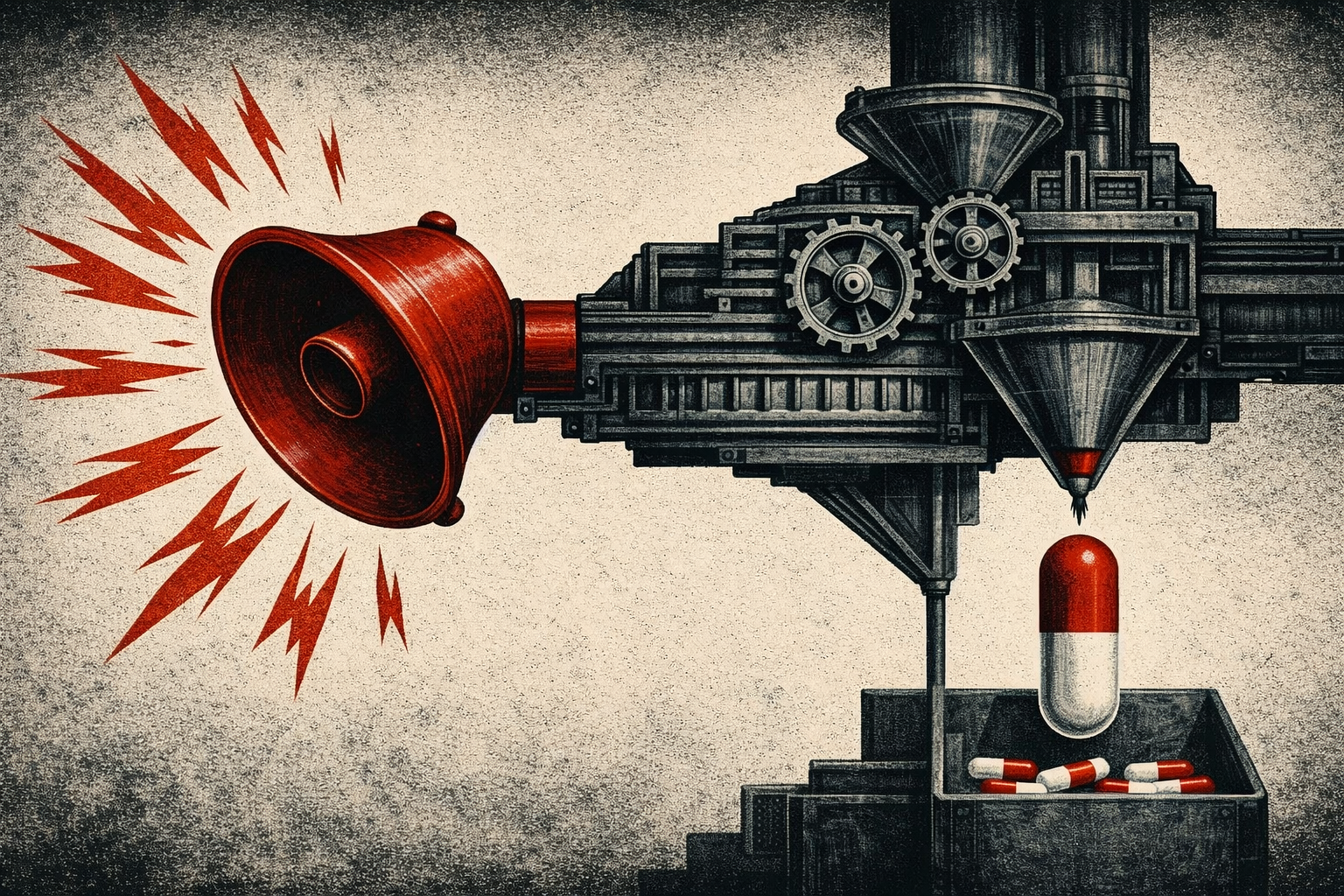
Mood Stabilized, Spirit Crushed
Bipolar diagnoses are rising sharply, especially among the young. Psychiatry frames the surge as progress: disorders once missed are finally being recognized.
But another possibility sits beneath the celebration.
A society under escalating pressure produces escalating distress. Institutions built to manage individuals are then asked to absorb what is fundamentally structural strain.
The result is predictable.
Systemic rupture appears in clinical charts as personal malfunction.
The experience is familiar.
Periods of electric urgency followed by hollow collapse. Energy that feels too large for the life surrounding it. Exhaustion that feels heavier than circumstance alone can explain.
The clinical interpretation is immediate: chemical imbalance.
Once the frame is accepted, the solution space narrows.
Mood stabilizers. Antipsychotics. Adjunct medications for the side effects of the first medications.
Instability is redefined as biology.
The surrounding environment disappears from the equation.
Human emotional systems evolved as detection mechanisms.
They register threat, injustice, dislocation, overload.
Under certain conditions those signals intensify. They become loud, disruptive, impossible to ignore.
Institutions responsible for maintaining functional order cannot treat every alarm as valid.
Some alarms must be reclassified.
What once signaled rupture becomes symptom.
Modern psychiatric treatment operates through long-term management.
A diagnosis early in life often leads to indefinite pharmacological maintenance. Mood stabilizers blunt extremes. Antipsychotics dampen volatility. Secondary medications manage sedation, agitation, or metabolic effects introduced by the primary drugs.
The system calls this balance.
Operationally, it is stabilization.
Not of the environment producing the distress.
Of the individual reacting to it.
Psychiatry does not operate in a vacuum. It sits inside insurance systems, liability structures, pharmaceutical markets, and clinical throughput pressures.
Those systems reward diagnostic clarity, medication adherence, and predictable management plans.
They do not reward open-ended investigations into social collapse, economic precarity, ecological dread, or cultural disintegration.
A diagnosis converts diffuse suffering into something billable, treatable, and administratively legible.
Ambiguous distress becomes a category.
The category becomes a treatment pathway.
The steepest increases in bipolar diagnoses appear among people aged fifteen to twenty-four.
This age group sits closest to the future horizon. Debt structures, housing instability, ecological anxiety, and digital saturation concentrate there first.
When systemic strain intensifies, early sensors tend to register it fastest.
Institutions read those signals differently.
They read them as pathology.
The maneuver is quiet but consistent.
Despair becomes diagnosis.
Rage becomes instability.
Withdrawal becomes dysfunction.
Once the label is applied, the conflict shifts location.
The problem is no longer the surrounding order.
The problem is the individual nervous system reacting to it.
Treatment proceeds accordingly.
Medication often works exactly as designed.
Extremes narrow.
Volatility fades.
The alarms grow quieter.
Function returns—at least enough to maintain participation in the same environment that triggered the signals in the first place.
From the system’s perspective, the intervention succeeds.
The distress did not disappear.
It was stabilized.
Reclassified.
And returned to circulation.
The system records the signal, classifies it, and proceeds unchanged.
Author's Note: This piece is a cultural and institutional critique informed by personal experience with a bipolar II diagnosis and psychiatric treatment. It does not argue that medication cannot help individuals. It questions the broader structures that define, categorize, and manage suffering at scale.