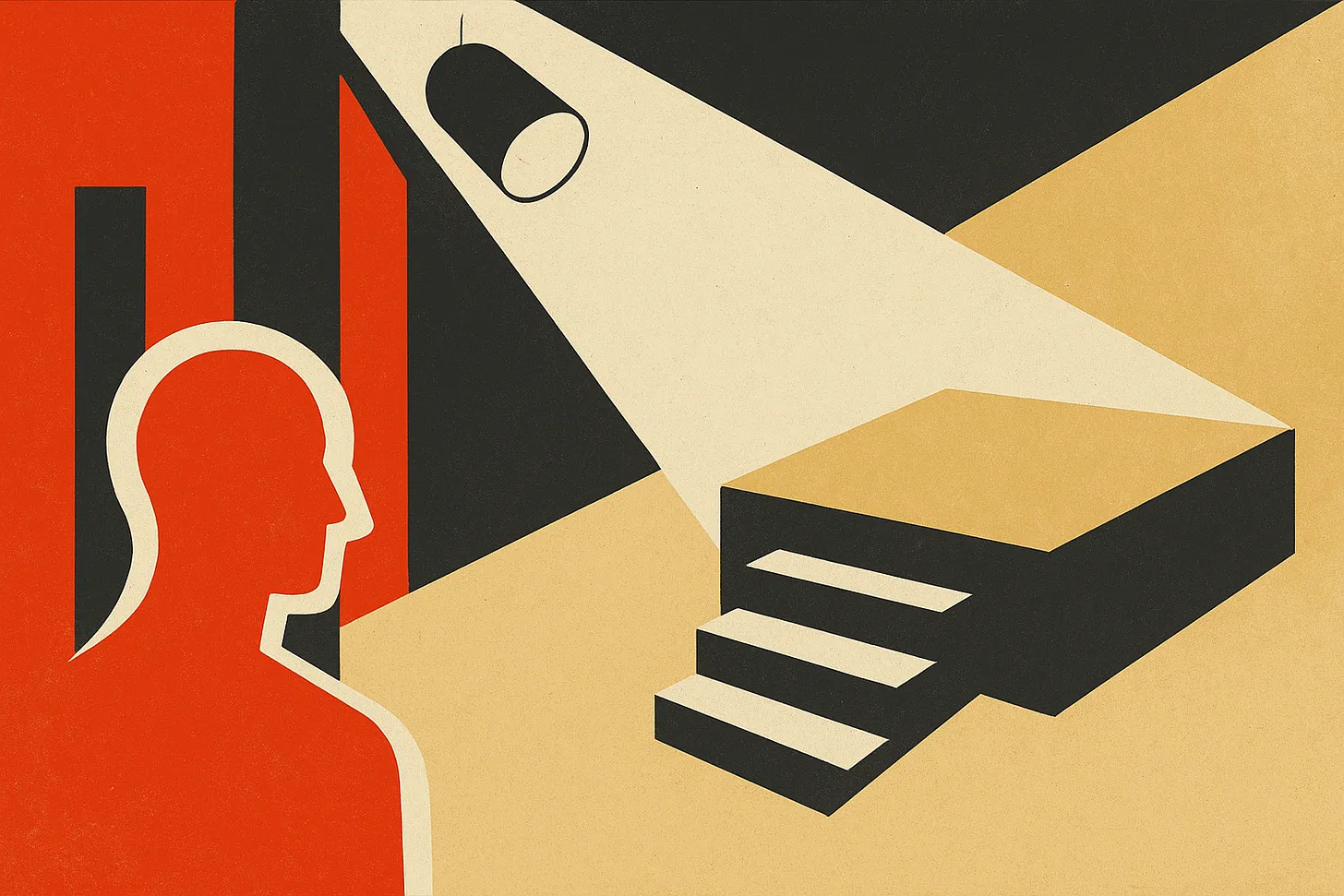
Performing Yourself to Death
Maybe you’ve been acting so long you forgot there was a script.
This isn’t about lying.
It’s about management.
Tone adjusted.
Expression calibrated.
Timing rehearsed.
Every room asks for a slightly different version of you.
After enough repetitions the adjustments stop feeling like effort.
They start feeling like identity.
Work calls it professionalism.
Platforms call it authenticity.
Schools call it maturity.
What they measure is legibility.
A person who can be quickly interpreted.
Quickly evaluated.
Quickly placed inside a role.
Performance reviews rarely measure the work.
They measure the character performing it.
Confidence signals.
Alignment signals.
Productivity signals.
A system built on optics rewards the people who edit themselves most efficiently.
So the editing never stops.
Even honesty learns presentation.
Even rebellion develops stage direction.
Every impulse passes through a filter:
Would this sound right?
Look right?
Advance the role?
The answer decides what survives.
The rest disappears.
Over time the mask stops feeling external.
It becomes muscle memory.
Burnout isn’t exhaustion from work.
It’s exhaustion from containment.
Relationships form between performances.
Personas interacting with personas.
Approval circulating between masks.
Success scales the same mechanism.
Titles.
Followers.
Stages.
The script tightens.
The rewards depend on staying in character.
Eventually the performance becomes the only thing that moves.
Not truth.
Not curiosity.
Performance.
The system prefers it that way.
Reality is difficult to measure.
Performance is effortless to grade.
So the machinery selects for people who can edit themselves fastest, longest, and most convincingly.
The winners rise.
The role stabilizes.
And the person who began the performance is no longer required.