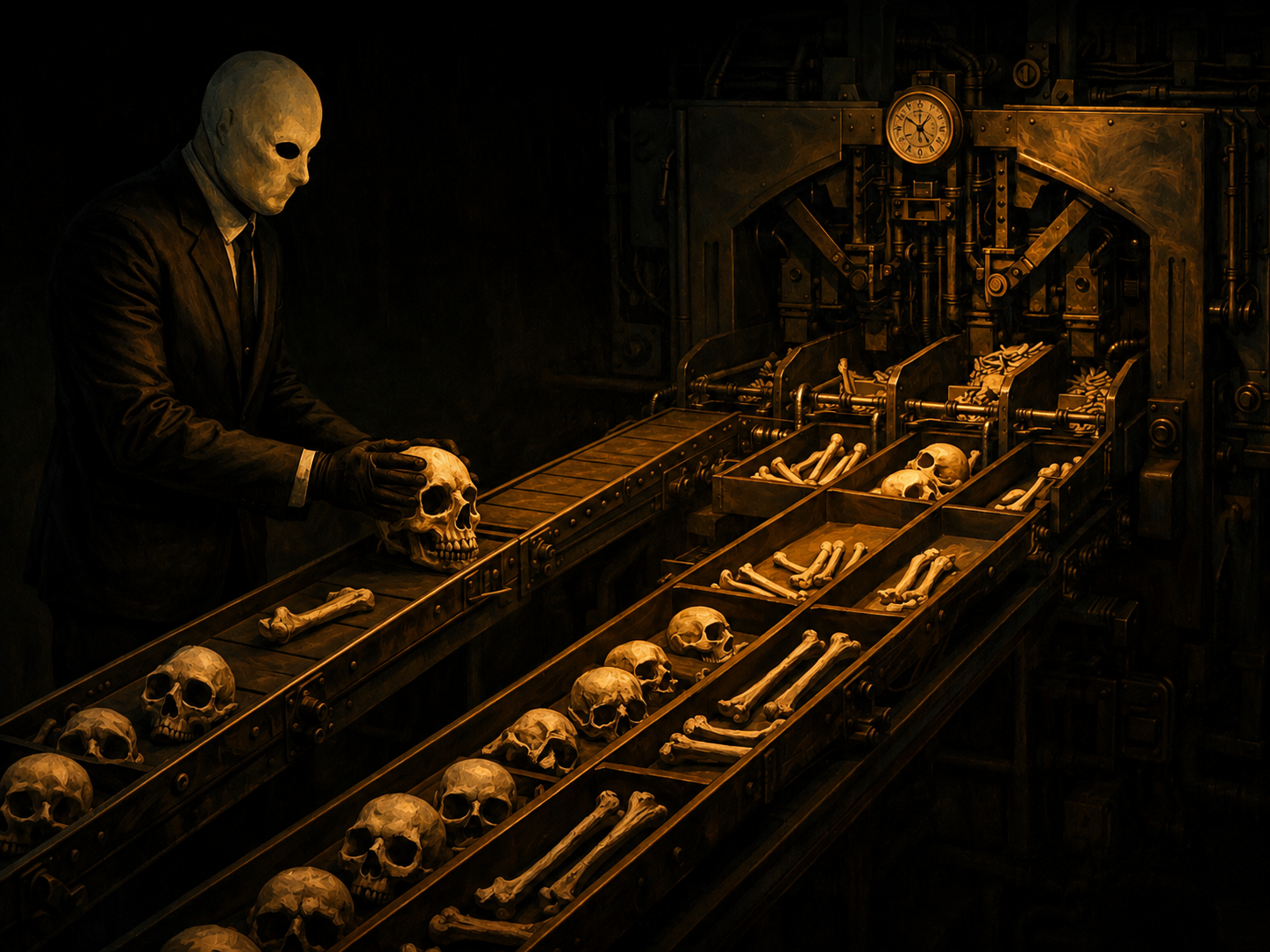
The Possession Engineer
He begins by deleting the person. Reduce the human frame to function and the rest becomes manageable.
He does not pursue; he selects. The question is feasibility: can it be kept.
Control is his stable state. Not struggle—removal of resistance. Silence, stillness, the elimination of independent will.
He constructs a closed system. Entry can appear voluntary. Inside it, the other cannot leave, contradict, or exist outside his design. When reality intrudes, it is suppressed as interference.
You encounter him where autonomy should be assumed. He does not request compliance. He restructures the environment until compliance is the only remaining behavior.
Emotion disrupts precision. His movements follow administrative order: acquisition, neutralization, retention.
Violence is not spectacle. It is indexing—reorganizing the body into controllable components.
Consumption is not hunger. It is attempted merger. If boundaries cannot guarantee possession, he dissolves them.
Normalcy is part of the system. Politeness grants access. Routine shields the machinery beneath.
His vocabulary replaces morality with procedure. Actions become sequences. People become variables.
Remorse has no place in the procedure. It would require recognizing the person the procedure erased.
The escalation is not progress. It is maintenance. The system must run continuously because permanence—the outcome he is engineering—never occurs.
The mechanism is simple. He seeks a form of possession reality does not permit and attempts to manufacture it through force.
Only a machine built for one function: to keep what cannot be kept by destroying everything that would allow it to leave.