The Wall
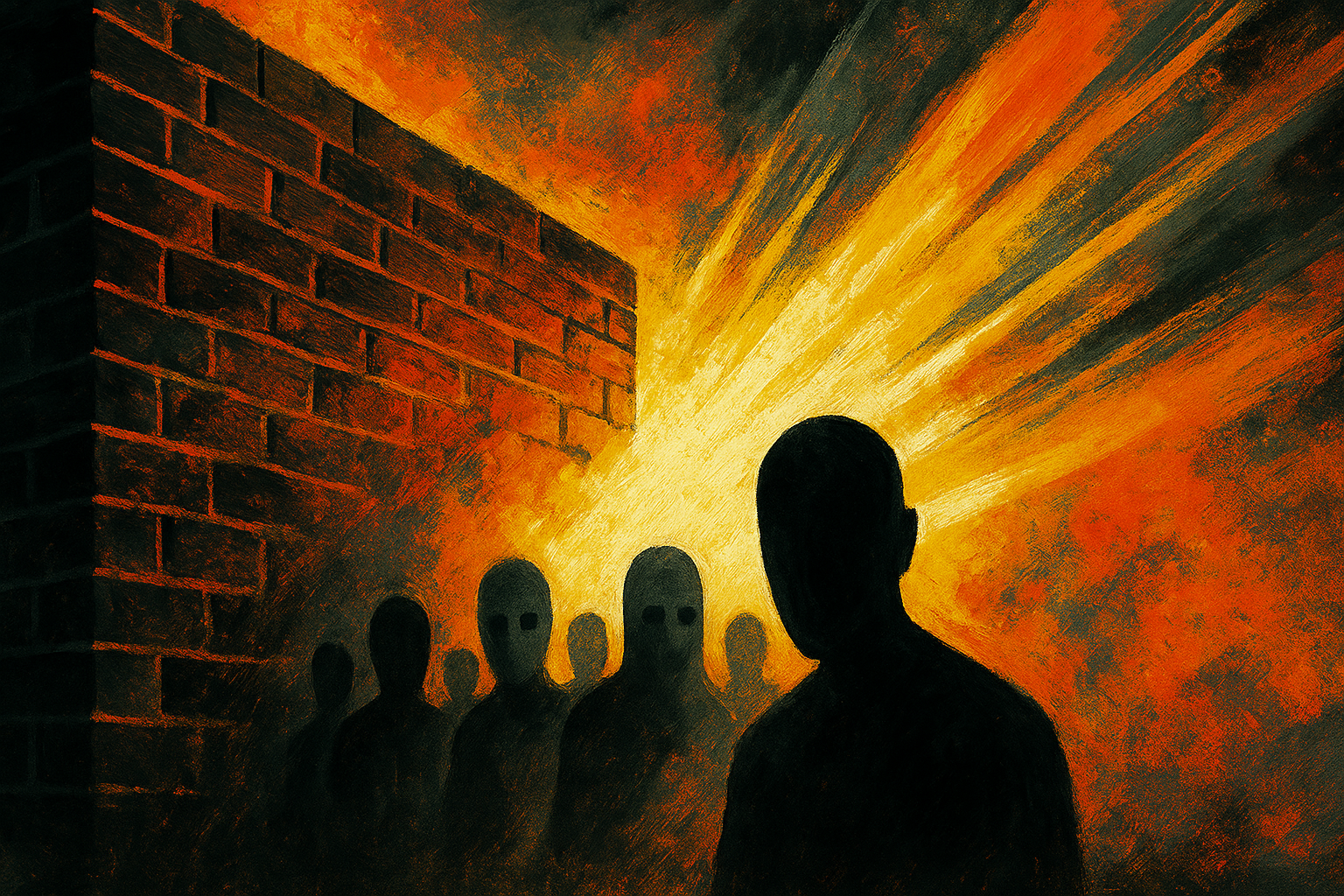
A wall is never just a barrier. It is a decision about what must remain unseen.
Power learns this early. Not through doctrine, but through reflex — the instinct to survive light. When scrutiny approaches, the surface thickens. When truth draws near, another layer is poured.
Over time, the structure stops pretending to protect anything outside it. It develops an interior logic, a silent geometry. What began as concealment becomes something else: a monument to what cannot endure exposure.
The wall evolves. It absorbs gestures, postures, tones — residue from those who rely on it. It takes impressions the way stone takes pressure: automatically, without intention.
None of these impressions belong to the individuals who perform them. They are features of the wall itself — interchangeable, repeatable, endlessly transferable. The human face is only the conduit. The structure is the continuity.
Stand close enough and you feel the tension in the material. Narrative settles into its seams. Institutions bend around its curvature without needing to be told.
No one claims authorship. No one notices their own outline on the surface. The wall requires neither.
And yet the material shows strain. Fractures radiate from contact points no one remembers making. Discoloration spreads where the light persists. A shallow depression forms where something once pressed outward and was forced back.
A wall records what it excludes. This one records what it sustains: not people, not principles — the appearance of coherence.
Observers sense distortion but cannot isolate the source. They interpret affect as intention, gesture as depth, pattern as personhood. They search for what lies beneath.
There is no beneath. It is surface without end.
When the wall completes itself, nothing will collapse. Nothing will be revealed. The architecture will remain intact, performing exactly as designed.
Sheathed for now. The wall is still assembling.